
Home Crawl Space Waterproofing Services in Charlotte, NC
A wet crawl space compromises your home’s structural integrity, spikes monthly energy costs, and severely degrades indoor air quality. Standing water and persistent sub-floor moisture lead directly to wood rot (rot fungi thrive at wood moisture contents above 20%), foundation settling, and toxic mold colonization.
At Fresh Air Technologies, we provide engineered interior and exterior crawl space waterproofing solutions specifically designed to withstand the unique soil compositions and high water tables of Charlotte, Matthews, and the surrounding Piedmont region.
What Causes Water in a Charlotte Crawl Space?
Crawl space water intrusion typically stems from three primary environmental and structural vulnerabilities:
- Hydrostatic Pressure & High Water Tables: North Carolina Piedmont clay soils retain significant volumes of water. Our local red clay acts like a sponge, expanding when wet and holding water against your foundation walls long after the rain stops. During heavy rain events, this water creates upward and inward pressure against your foundation footings, forcing moisture through porous concrete block walls and cold joints (where the foundation wall meets the footer).
- Negative Exterior Grading: Dirt and landscaping beds sloped toward the foundation trap water against the exterior walls rather than shedding it away from the home.
- Inadequate Roof Drainage: Damaged gutters or short downspout extensions dump hundreds of gallons of water directly next to the crawl space perimeter wall.
The Science Behind Dry Crawl Spaces: Meet Our Founder
Most waterproofing companies employ salespeople; we are led by an environmental scientist. Jay Lanzy, Principal Owner of Fresh Air Technologies, is an Environmental Geologist with over 25 years of experience in environmental consulting and hydrogeology.
- Why a Geologist Matters for Your Home: Charlotte’s heavy Piedmont clay soils and shifting water tables require more than a standard retail fix. Jay’s geological background means every interior and exterior waterproofing system we install is engineered based on local soil mechanics, hydrostatic pressure patterns, and groundwater hydrology.
- Scientific Protocols: We don’t guess where water is coming from. Under Jay’s leadership, every project is executed using written, data-driven environmental protocols to permanently protect your foundation, prevent structural rot, and guarantee the health and safety of your family.
The Piedmont Geology Beneath Your Charlotte Crawl Space
Charlotte sits in the Piedmont, where the soil under your home didn’t wash in from somewhere else — it formed in place, weathering down from the crystalline bedrock below over geologic time. Geologists call this residual soil, or saprolite. The result is a deep, clay-rich profile that behaves very differently from the sandy soils or imported fill common in other parts of the country, and it’s a major reason crawl spaces stay wet here.
Not all of our local “red clay” is the same, though, and the difference between one clay and another determines whether your home’s problem is standing water, a shifting foundation, or both. This is where reading the ground matters more than a standard retail waterproofing script.
Why Water Sits Under Piedmont Homes
Beneath the topsoil, Piedmont residual soils develop a dense, clay-rich subsoil over partially weathered saprolite and, eventually, solid rock. That clay layer has low permeability, which means that water moves through it slowly. During the wet season, rain can’t drain downward fast enough, so it perches on top of the dense clay and travels sideways toward the path of least resistance. Too often, that path is the disturbed backfill around your foundation footing.
The clay then does two things at once.
1.) It holds moisture against your block walls long after the rain stops, and
2.) It builds hydrostatic pressure that drives water through porous concrete blocks, mortar joints, and the cold joint where the wall meets the footer.
That is the water-intrusion mechanism behind most wet crawl spaces in our area, and it’s why drying a crawl space without managing water at its source rarely holds up over the seasons.
The Two Clays that Matter & a Common Misconception
Charlotte’s red clay is, across much of the area, the Cecil series — North Carolina’s official state soil. It weathered from felsic rock (such as granite and gneiss) and is rich in kaolinite, a comparatively stable clay mineral with low shrink-swell potential.
It drains slowly and holds water, which is what drives the hydrostatic pressure described above, but it does not dramatically expand and contract with moisture.
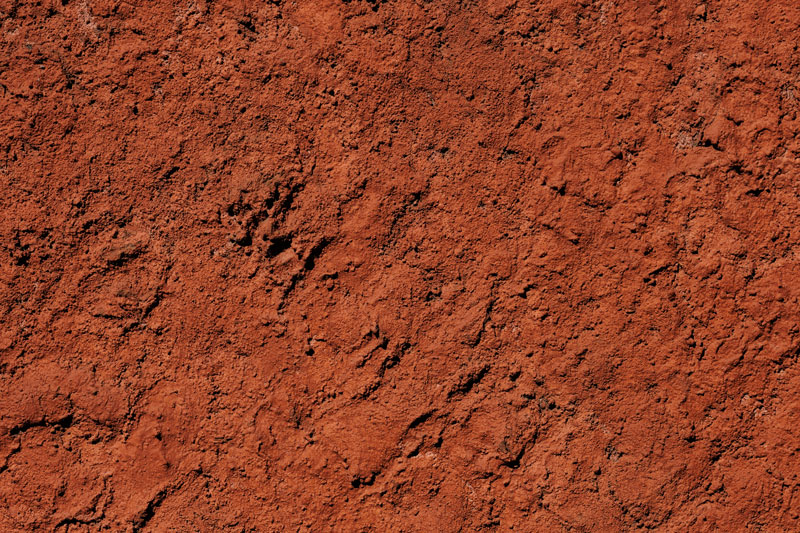
The soils that physically move foundations are different. Scattered through the region, often in lower and wetter pockets, are darker clays weathered from mafic (iron- and magnesium-rich) rocks such as diabase. The best known locally is the Iredell series, which many contractors and homeowners call “bull tallow.” These are rich in smectite — the most expansive clay mineral there is.
Smectite draws water into its mineral structure and swells, then shrinks and cracks into fissures as it dries. On these soils you get the classic seasonal cycle: a foundation settles during dry spells as the clay contracts, then lifts during wet months as it expands, producing stair-step brick cracks, sticking doors, and uneven floors.
This is why the popular line that “red clay acts like a sponge and expands when wet” is only half the story, and why the distinction matters for your home. The red Cecil clay is primarily a drainage and hydrostatic-pressure problem. The darker smectitic clays are primarily a soil-movement problem. Many homes sit on a transition between the two, which is exactly why an effective system has to be matched to the ground a house is built on rather than pulled off a shelf.
Signs You Have an Issue in Your Crawl Space
Many homeowners will not visit their crawl space often. However, if you start to notice one or more of the following signs of a crawl space issue, it may be time to have a professional Fresh Air technician take a look:
- Musty odors on the first floor: That damp, earthy smell is often your earliest warning, and it rarely stays put. Because air rises out of the crawl space into your living areas (the stack effect), odors from mold, mildew, or decaying wood beneath the floor travel straight up into the rooms you use every day.
- Cupping or warping hardwood floors: Wood is hygroscopic, meaning it constantly absorbs and releases moisture from the surrounding air. When humidity rising from an unsealed crawl space reaches the underside of your flooring, the boards swell unevenly, causing edges to lift (cupping) or planks to twist and crown.
- Unexplained spikes in summer cooling bills: a damp crawl space forces your air conditioner to work harder than it should. Humid air is far more energy-intensive to cool than dry air, and when ductwork runs through a moist sub-floor, that added moisture load can quietly drive up your summer energy costs.
- Sticking doors or windows (signaling foundation settling): When frames start to rack out of square, it often points to movement in the foundation below. Seasonal moisture swings in the clay soil can cause the ground beneath a foundation to shift and settle unevenly, pulling door and window frames out of alignment throughout the home.
The Fresh Air Technologies 4-Tier Waterproofing System
Our certified technicians use a multi-layered approach to guarantee a permanently dry, healthy sub-floor environment.

1. Sub-Floor Perimeter Drainage & Pipe Sloping
To capture water at its primary point of entry before it pools on the dirt floor, we excavate a trench around the interior perimeter of your foundation footings.
- Perforated Drain Tile: We install a schedule-30 perforated interior drainage pipe wrapped in a heavy-duty, non-woven geotextile filter fabric. This prevents fine North Carolina clay silt from clogging the drainage system over time.
- Engineered Sloping: The trench and piping are meticulously sloped at a minimum grade of 1/4-inch per linear foot, naturally directing collected groundwater straight to the sump pump basin.

2. Commercial-Grade, Airtight Sump Pump Systems
Gravity feeds the collected perimeter water into a heavy-duty, airtight sump basin.
- Heavy-Duty Pumping Power: We install professional-grade Zoeller 1/3 horsepower cast-iron submersible sump pumps, capable of moving up to 43 gallons of water per minute at a 5-foot dynamic head.
- Dual/Airtight Lids: Our basins have a specialized structural foam lid featuring a perimeter gasket seal. This creates a completely airtight integration with the vapor barrier, preventing radon gas, moisture, and pests from escaping back into the crawl space.
- Integrated Flood Alarms: Every setup includes an audible high-water alarm system to instantly alert you in the rare event of a mechanical or power failure.
3. Heavy-Duty 20-Mil Vapor Barrier Membrane
An open, unlined dirt floor continuously releases gallons of water vapor daily via capillary action. We seal this off entirely.
- True 20-Mil Thick Polyethylene: Unlike thin retail-grade liners that tear easily, we install a multi-layered, string-reinforced 20-mil vapor barrier.
- Complete Encapsulation Wrap: The membrane is laid flat across 100% of the crawl space floor, overlapped a minimum of 12 inches at all seams, and permanently sealed with water-resistant seam tape. The barrier is extended a minimum of 6 to 12 inches up the foundation walls and securely pinned and sealed with polyurethane sealant.

4. Cold-Weather Crawl Space Dehumidification
Even with an airtight barrier, warm, humid summer air can find its way inside and condense against cold overhead ducts.
- High-Capacity Low-Temp Units: We install specialized, energy-efficient crawl space dehumidifiers designed to extract between 70 and 90 pints of moisture per day. These units feature automatic hot-gas defrost bypass valves, allowing them to operate highly efficiently even in cold crawl space environments down to 40°F.
- Optimal Relative Humidity (RH): Our systems are calibrated to permanently maintain relative humidity levels between 45% and 55%—the critical threshold required to completely stop mold spore germination and prevent wood-boring pests.
Interior vs. Exterior Crawl Space Waterproofing: Which is Right for You?
Have a question on the differences between interior and exterior waterproofing? Let’s break down each waterproofing method to see which is right for your home:
| Feature / Detail | Interior Waterproofing System | Exterior Waterproofing System |
|---|---|---|
| Primary Mechanism | Captures and manages water after it crosses the foundation footprint, routing it away via sump. | Blocks water before it can physically touch or penetrate the foundation wall exterior. |
| Installation Method | Sub-floor interior trenching, perimeter pipe installation, and sump basin integration. | External excavation down to the footing, application of elastomeric waterproofing membrane, and installation of dimple board. |
| Landscape Impact | Zero. All work is performed entirely under the footprint of the home. | High. Requires excavation of exterior soil, plants, patios, or walkways adjoining the wall. |
| Best Used For | High water tables, hydrostatic pressure from underneath, and homes with complex exterior hardscaping. | Surface water issues, severe wall saturation, and homes where sub-floor clearance is too restricted for interior labor. |
How Much Does Crawl Space Waterproofing Cost in Charlotte?
The total cost for a professional crawl space waterproofing and encapsulation project will depend heavily on several key field variables:
- Crawl Space Footprint: Total square footage dictates material volume (20-mil membrane, drainage piping, gravel).
- Existing Condition: Active structural mold growth requires specialized dry-ice blasting and remediation protocols before sealing can begin.
- Clearing & Grading: Height clearance limitations and the volume of saturated red clay or structural mud debris that our crews must manually excavate out to achieve proper slope dynamics.
Crawl Space Waterproofing FAQs
Here are some of the most frequently asked questions we get about our crawl space solutions. If you have further questions, don’t hesitate to give us a call at (704) 270-2721:
Yes. Crawl space waterproofing stops mold growth by eliminating standing water and dropping relative humidity below 55%. Mold spores require consistent relative humidity levels above 60% and a wood moisture content over 19% to grow. By combining a 20-mil vapor barrier with an industrial dehumidifier, you completely strip the environment of the moisture mold needs to survive.
Crawl space waterproofing focuses strictly on capturing, managing, and evacuating liquid groundwater using tools like perimeter French drains, sump pumps, and exterior dimple boards. Crawl space encapsulation is the process of completely sealing the space from air and moisture vapor by covering the ground and walls with an airtight plastic membrane and sealing off foundation vents. For best results, a wet crawl space requires a combination of both systems.
No, you cannot use a standard residential dehumidifier in a crawl space. Standard home units are designed to operate in spaces above 65°F and lack the airflow capacity to handle high-moisture sub-floors. Crawl space dehumidifiers are specifically engineered to extract up to 90 pints of water per day in low-clearance, cold environments (down to 40°F) and feature automated drainage lines so they never have to be emptied manually.
Crawl Space Waterproofing Services Across Greater Charlotte
Fresh Air Technologies provides engineered residential crawl space waterproofing and encapsulation solutions throughout the Greater Charlotte metropolitan area. From the dense Piedmont clay lots of Uptown and Ballantyne to the shifting water tables of Concord, Gastonia, and Rock Hill, our geologist-led team specializes in defending local homes against severe sub-floor moisture.
Our unique environmental consulting background means we understand how groundwater hydrology impacts foundations differently across our region. We provide data-driven drainage systems and structural encapsulation for historic properties in Matthews, fast-growing neighborhood developments in Huntersville, and lakeside homes vulnerable to high humidity in Cornelius and Mooresville.
We are fully fluent in the specific climate challenges, soil mechanics, and residential building codes of Mecklenburg, Union, Gaston, and York Counties, ensuring your home’s foundation remains permanently dry, stable, and structurally sound.
Why Residential Customers Choose Fresh Air Technologies
- Over 25+ Years of Local Service: We have protected homes across Charlotte, NC, and the surrounding Piedmont region for more than twenty-five years.
- Written, Standardized Protocols: We do not guess. Every waterproofing project is backed by an explicit, science-based technical protocol tailored to your specific foundation structure.
- Indoor Air Quality Experts: Because up to 50% of the air you breathe on your first floor originates in your crawl space (the Stack Effect), our technicians are strictly trained in total indoor air quality safety, structural mold remediation, and long-term environmental control.
Contact Us for Crawl Space Waterproofing Solutions!
Fresh Air Technologies provides a comprehensive, itemized waterproofing report complete with clear field photography and precise moisture data points. This allows you to see exactly where water intrusion is occurring beneath your home and break your drainage and waterproofing project down into step-by-step financial phases—all with zero obligation.
Find out more about our crawl space waterproofing solutions and other crawl space services here.
- Inquiries: Contact us to schedule a comprehensive crawl space evaluation or site assessment.
- Company: Fresh Air Technologies
- Office Phone: (704) 270-2721

